Film Filings — September 2026
Summary
In this edition of Film Filings, Poss reviews the titanic-title of 2026: Christopher Nolan’s The Odyssey. Christopher Witty reviews the BBC folk-horror adaptation of Alan Garner’s The Owl Service; plus, a snapshot reviewsby Witty of the unique adaptation of H.P. Lovecraft’s The Call of Cthulhu from 2005; Nathan Gilmore reviews the late-masterpiece of John Ford’s American myth-making: The Man Who Shot Liberty Valance, then Yojiro Takita’s Departures from 2008, and Spielberg’s all-too-relevant AI: Artificial Intelligence from 2001. Rounding us off is Sam Stephens’ review of the 1996 Hamlet, Kenneth Branagh’s catch-all adaptation of Shakespeare’s most famous play.
POSS REVIEWS THE ODYSSEY (2026)
Over at his blog, Poss tackles the Big One of 2026, the inescapable Nolan Odyssey. He writes:
“To begin with what I liked, The Odyssey is hugely entertaining. That’s the basic standard a good movie must meet, and as a movie The Odyssey is astonishing. (Its quality as an adaptation of a great work of literature is a separate question, which we’ll return to.) The film is technically accomplished, the IMAX cinematography and the staging of the many action scenes expertly done, and the special effects seamless. The vast, cast-of-thousands scale of sequences like the Fall of Troy is overwhelming in the best sense. And for all his practical effects street cred, Nolan wisely used CGI in a number of appropriate places, a lesson seemingly learned from the underwhelming attempt to mimic the atomic bomb with a practical gasoline explosion in Oppenheimer. And I’ll go ahead and say here that I think The Odyssey is a much better movie than that one.”
CHRISTOPHER WITTY: TV’S THE OWL SERVICE
The Owl Service (dir. Peter Plummer, 1969-1970) — Republished with permission from @filmfolkuk
An eight part television adaptation of Alan Garner's novel that has since gained cult status with the adults who are old enough to remember scratching their heads over it when it was first broadcast over the winter of 1970. For a kid's book and show, the ambiguities surrounding the link between a local Welsh myth and the dinner service of the title, and which the plot hangs itself on, are never fully explained; but then I guess that's the nature of myth: open to reinterpretation and able to attach itself to something tangible connected to the teller, leaving it in a state of flux.
All of the vaguely supernatural elements of the story underpin a secondary plot involving blossoming teenage sexuality and class distinction. A fractured English family (Alison, her offscreen tyrannical mother Margaret, stepfather Clive and his son Roger) either succumb to their feelings or lock horns with the locals (the family's bitter cook, her son Gwyn, groundskeeper Huw), while a myth surrounding a love triangle seemingly re-enacts itself through the children.
The past resurfacing (a common theme in folk horror, and which The Owl Service has retrospectively been categorised as) reveals itself not only in local legend but in the secrets kept by the adults from their children. That the kids then suffer the fall out is what makes the story an almost tragedy; Alison is taken possession of by forces awakened by the discovery of the service, Gwyn is trapped by his domineering mother, and Roger struggles to crawl out from under his father's shadow whilst carrying the shame of his mother's infidelity.
Everything feels slightly askew in The Owl Service, as though the players are being watched and controlled by the landscape: Gwyn clambering up a slope to escape his rural confinement appears to lead nowhere; Huw (always outdoors and connecting to the land) is an ever-present reminder of both the ancient and recent past; Roger finding ghosts in his photographs. And when the past attacks Alison, leaving her scarred and gluey with feathers, the entire scene is played out with such reserved Englishness that we can imagine the incident will never be spoken of again. The past, left to settle amongst the leave and moss, will return quietly to its place beneath the soil and wait for the next suitable party to take on the roles of mythical figures.
…
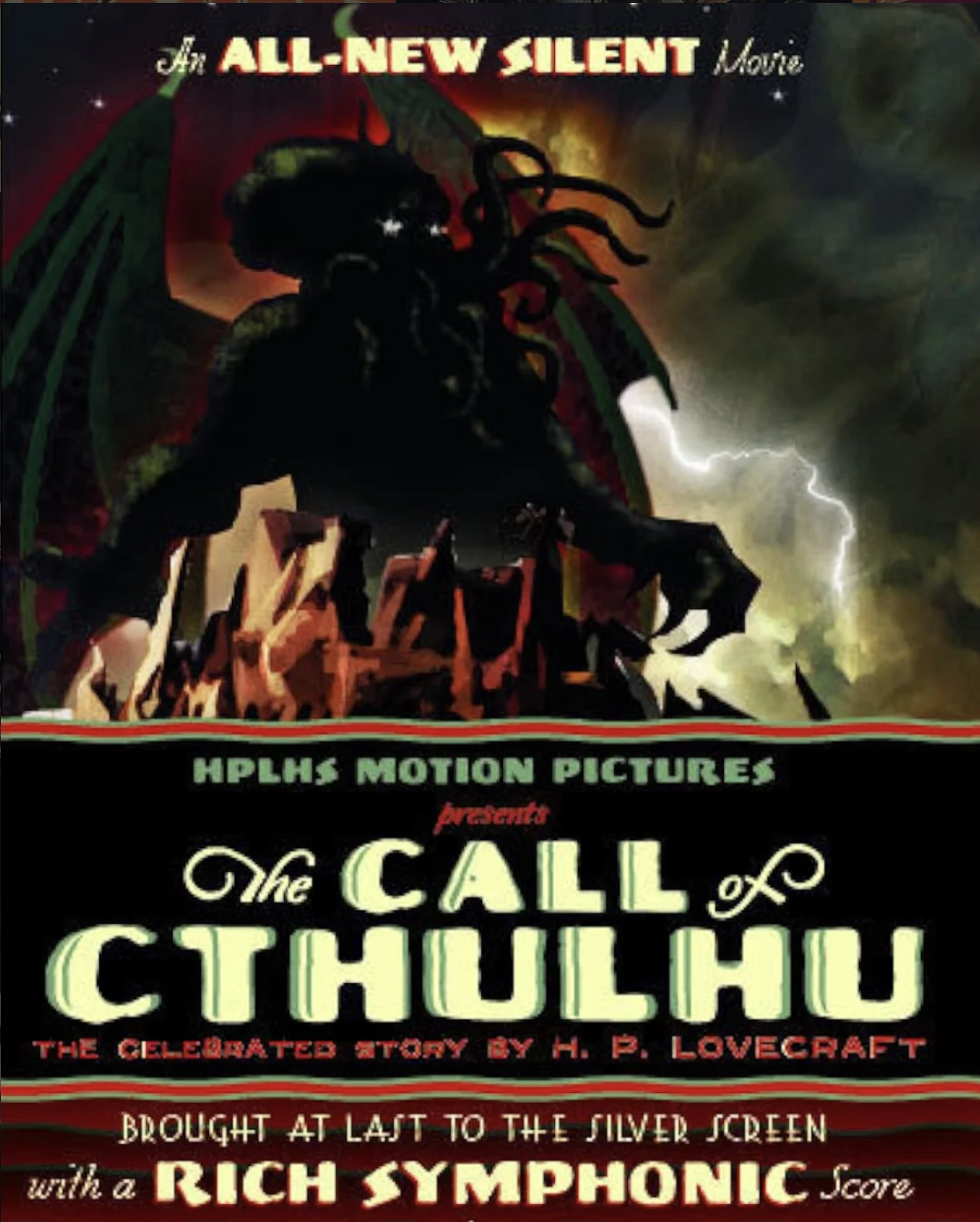
The Call of Cthulhu (2005) dir. Andrew Leman
As faithful an adaptation of Lovecraft's story as one could hope for, this 47 minute gem is a loving homage to the silent movie era as much as it is to the writer himself. So much so, in fact, that you can easily be led to believe it could have been released in the same era as such classics as Nosferatu, The Hands of Orlac, and The Cabinet of Dr. Caligari. The expressionist lighting and set design of those horror milestones are accurately reproduced here, especially during a spectacular fever dream sequence with its jagged and infinitely decreasing frames. The score, editing, and use of montage, intertitles, iris shots, and variable camera speeds complete the whole, without once coming across as forced or gimmicky. And Cthulhu himself? Well, for a story long considered unfilmable, the FX department show what simple puppeteering and stop motion can achieve in the absence of CGI. A triumph.
NATHAN GILMORE: THREE REVIEWS
The Man Who Shot Liberty Valance (1962), dir. John Ford
How the West was run. “The Man Who Shot Liberty Valance” opens with a flashback. A U.S. senator by the name of Ransom Stoddard arrives in the town of Shinbone to pay his respects to one Tom Doniphon. How the two came to know each other, a senator and a commoner is the story told in flashback.
Back in the day, before senators lay in state at the courthouse, Shinbone was terrorized and ruled by one Liberty Valance. His name is a delicious irony, for Liberty is a man for whom the law is defined by the man with the quickest draw. Liberty has become the law of the town of Shinbone because he is the meanest man in it. Liberty (played with savage relish by Lee Marvin) isn’t just a gunslinger— he prefers the sadism of a leather bullwhip. Like most bullies, Liberty has a couple of cowards for sidekicks, and they enjoy terrorizing the town and any passing stagecoaches. It is on one of these stagecoaches that the gang runs into Ransom Stoddard, attorney at law, and nearly beat him to death. Luckily for Ranse, Tom Doniphon happens along and takes him to the town of Shinbone to recuperate.
James Stewart is Ransom, a man of deep intellect and strongly-held theories about justice, and he is about to have those theories sorely tested. As Ransom recovers, he is attended by the hostess of the local inn and Doniphon’s girlfriend Hallie.
It is obvious that there are essentially two ways to deal with Liberty Valance, and both are represented by the most perfect characters to do it: Ransom, the attorney, wants to let the law handle the case, and Doniphon would rather handle his own business. Are Stewart and Wayne typecast here, yes they are. But it turns out perfectly. You can see echoes of George Bailey in Stewart’s performance as Ransom— that desperate idealism, that hoping against hope that the good in the world and in people will somehow win out in the end.
Doniphon, of course, is John Wayne: a hard-bitten man of action, whose moral code is no less honorable for being backed up with a revolver instead of a rulebook.
It’s this contrast in character that is the great pleasure of the movie, as well as the gleeful malevolence of Liberty and his gang. Doniphon sort of dismisses Ransom as a naive idealist whose principles will be the death of him, but Ransom is no fool, and no martyr. His allegiance is true, and his loyalty is not merely to the letter of the law; it’s to the spirit as well. The struggle is bigger than two men, and we the audience know it. It’s fascism vs. democracy, the strongman against the common man.
That comes to a head when Ransom ends up killing Liberty in a standoff that exposes Liberty for the small, mean coward that he is, but also gives him a stunning shimmer of humanity. Every man who became a monster was still a man once— maybe it’s easier for a man like Doniphon to forget that, but it ends up being the humane, idealistic Ransom who pulls the trigger, and that act of violence that launches his political career. The second half of the movie veers away from the western narrative into a political one, reminiscent of “All The King’s Men” and “Mr. Smith Goes to Washington”, but it veers with aplomb. Which do we choose? Idealism or vengeance? Principled peace or principled violence? The courtroom scene toward the end is a masterpiece of multilayers: oratory, law vs. mercy, force vs. goodwill. This isn’t Gunsmoke— it’s Plato! I won’t give away the ending, but “The Man Who Shot Liberty Valance” is less about the story as it happens than it is about the way we remember the story and apply our own interpretations and biases to it. How we feel about justice. And how we justify the actions that we take in executing our version of it.
“The Good, The Bad and The Ugly” is the style king of Westerns. But “The Man Who Shot Liberty Valance” is the poet philosopher of the Western genre. Brilliant.
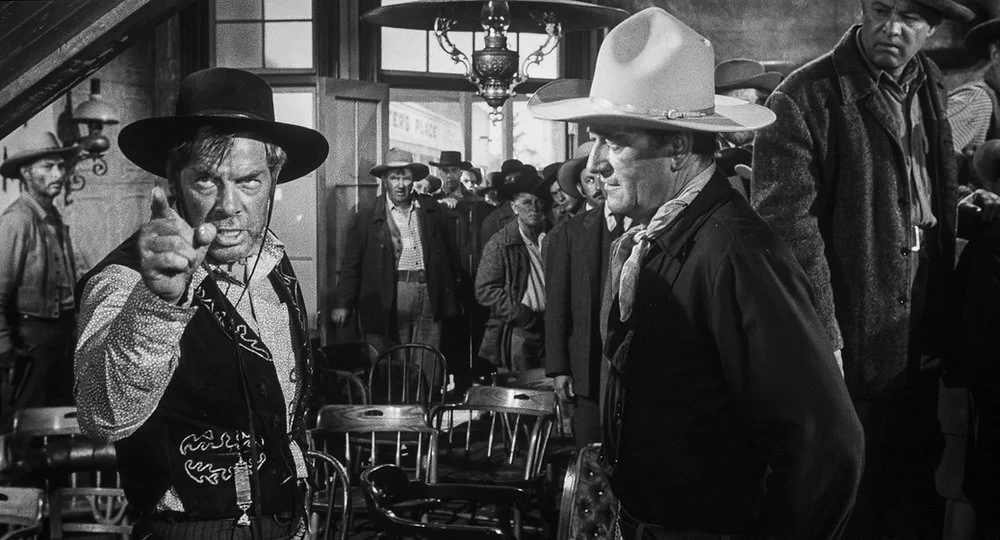
Lee Marvin is a menace.
…
Departures(2008), dir. Yojiro Takita.
“Dying is an art, like everything else.”— Sylvia Plath
When I watched “Departures” for the first time a few years ago, I cried a lot, which I don’t usually do at movies. Watching it now, I can more easily see some of its flaws. It is bombastic, and tearjerking. A good half- hour might be excised from the runtime without serious loss.
But I also remember what I loved about it, and why it went straight to the top of my Christmas list that year. It is, at heart, a fable. The story involves a young man, Daigo, who is fresh out of work as a cellist after his orchestra disbands. He answers a help-wanted ad in the paper. It is awkwardly worded “Departures”, and so Daigo applies for the position thinking he’ll start working as a travel agent. He is shocked to find that he has applied for work at an undertaker’s firm.
The boss of the firm is an elderly gentleman, both sympathetic to Daigo’s dismay and matter-of-fact about his profession. Give it a try, he says, if you don’t like it, you can quit. He pays Daigo up front, so Daigo rides along with him for some on-the-job training. It doesn’t go well— Daigo can hardly look at the corpses of his clients (well, his clients *are* corpses) without gagging. But over time, he becomes accustomed, then comfortable, and ultimately even proud of his profession.
His wife Mika takes a little more convincing. A sweet-faced young woman, she wants nothing more than to set up house and cook dinners for her husband while he works a respectable job— which rules out undertaking. But gradually, she comes to see the profession for what it is: a social necessity with a great deal of dignity inherent in it.
The scenes that will stick with the viewer the longest are the ones that involve preparing the body for burial. There is a delicate choreography here, undressing, cleaning and redressing the body. This is all done with the utmost care and respect— no part of the body is exposed that would not be inappropriate if the person were still living. The hands are positioned in a manner that suggests peace, and repose, and dignity.
And it is all done in view of the deceased’s family. This is different from the Western custom, where preparation is done behind closed doors and out of sight of the family. This is a more communal approach, where the family is given space and time to grieve, to weep and to remember. We see some decedents who may have not had the best relationship with their families: a transgender person, a runaway. But there is, in the understated Japanese way, a final acceptance of the person in death, even if it was impossible in life. And Daigo is a small part of that. The care and reverence he gives these departed are solace and reminders to the living that all life is worthy of respect and dignity— even at its end.
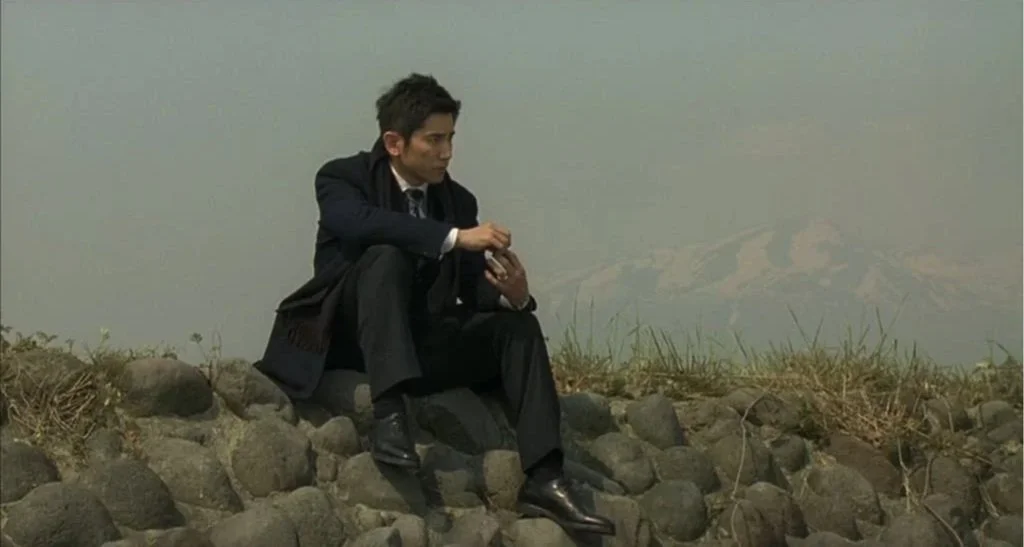
The director, Yojiro Takita, might have used a lighter hand. The most poignant scenes— of preparation, burial and grieving— are not likely to linger as long as the scene with Daigo inexplicably playing the cello on top of a mountain. The saccharine soundtrack sometimes drowns out the quiet, sometimes unspoken, wisdom of the narrative.
But with taken a little more grace and a little less cynicism, “Departures” is a sweet and moving meditation on life lived in view of death.
…
A.I Artificial Intelligence (2001), dir. Steven Spielberg
A real boy. “A.I.” is a movie of deep substance and almost bewildering implication. Sometime in the future, we are informed, robots have evolved to the point where they are capable of feeling— of love.
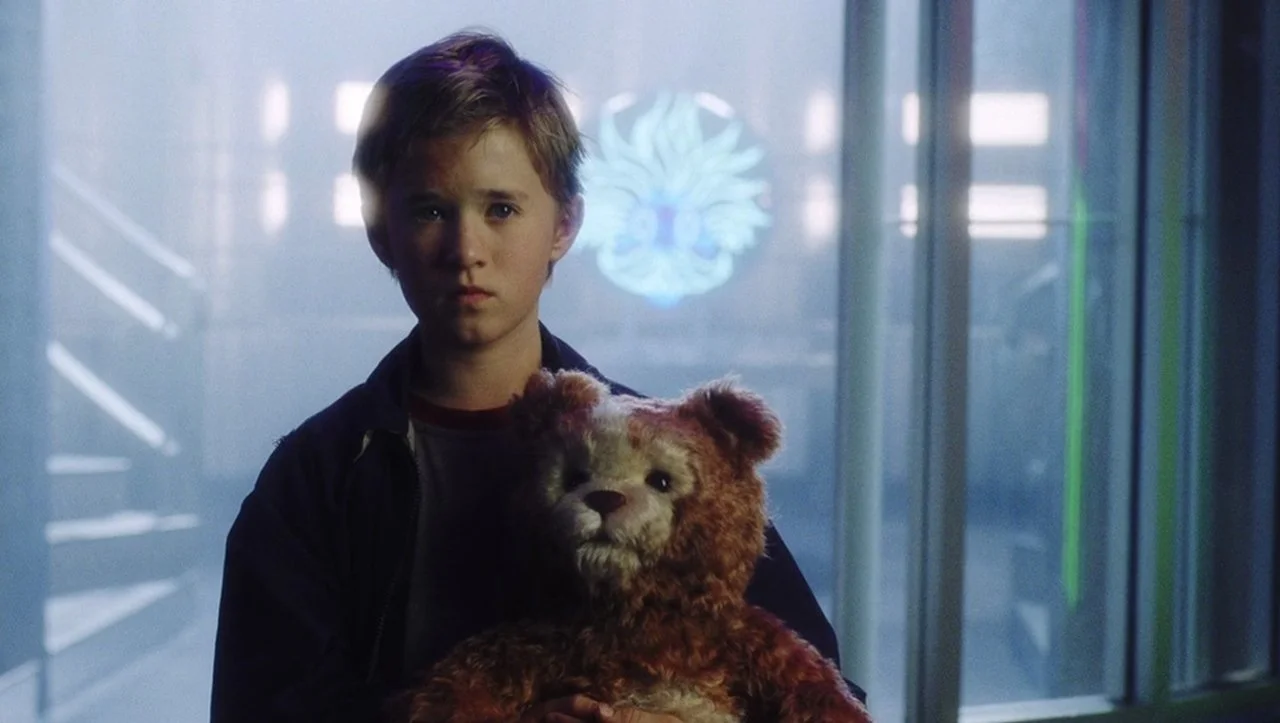
This is welcome news to Henry and Monica Swinton, whose child is sick. They bring him a new android named David, prepared to lavish their love on him, but when their child recovers, they are faced with the reality of fitting a robot into their very human lives. Here is where the conundrums begin. Their human child is unable to accept David as a real sibling; David so wants to be like his human brother that he stuffs spinach in his mouth, causing a face-melting malfunction that requires a trip to the hospital. Do Henry and Monica not explain to Martin that David is not a real boy? Does David not have some kind of self-preservation mechanism programmed into him?
And there are limits to Monica’s motherly instincts. David follows her around the house, creepily appearing out of nowhere while she tries to do housework. Frustrated, she shuts him in a closet. Should she have reacted like that to her human offspring, child protection services would have gotten involved. Is there no robotic equivalent— Android Protection Services? If one has the right to shut one’s appliance in a closet, then Monica is free to do what she likes with David. But then, can she truly love an appliance? Can he (it?) love her in return? We are told from the beginning that he can— that’s what he’s designed to do. But if love is a programmed response, is it real? Or just a reaction to programmed stimuli? What differentiates that, on a biological and social level, from human love?
David, of course, is not like other robots. He has the ability— or is it a glitch in his programming?— to yearn. Having convinced himself that his mother would love him more if he were real, he sets out to find a way to become real. Again, the implied questions are fascinating, and not really addressed by the movie. Does he grasp the concept of unconditional love? If he believes that love is conditional on his being real, does he believe that love is still worth having?
There are other characters with equally compelling implications. David is befriended by a lover robot (essentially a prostitute, or if you will, a sex toy), who takes him to an underground society of humans who pit robots against one another and cheer as they are destroyed. Why do the humans hate robots? We saw this with Martin’s innate animosity toward David. What in us drives us to abuse lower or lesser beings?
None of these questions are adequately answered in “A.I.”. The final act of the movie involves the pinnacle of artificial intelligence, embodied in luminous, alien-like beings who have evolved beyond humans. David is the last of their kind who has memories of the human race, and they ask to download his memories so that the record of humanity is not lost forever. There is a kind of eloquence and lyricism to these last scenes, a elegiac ode to being human, but again, this is not developed to any real substantive degree.
There is an emotional, sentimental side to Spielberg (see “E.T.”) that I think sometimes overshadows his logic. I wish I had more easily been able to suspend disbelief with this movie, to enter into its lyrical and emotional world. But I found it hard to separate the sci-fi from the poetry. There are many rich and startling concepts hinted at in “A.I.” (I’ve long had the draft of a sci-fi story dealing with robot prostitution knocking around in my computer). But the movie tries to make one grand philosophical statement that glosses over reality. I didn’t find myself moved by it so much as hoping that other movies would take its ideas and run with them.
SAM STEPHENS: BRANAGH’S HAMLET
Hamlet (1996) dir. Kenneth Branagh
In most ways, this Branagh’s Hamlet is a masterpiece. Branagh sets out to be crystal clear with an interpretation, and it helps immensely, but he can't help the material past a certain point: Hamlet is a true mystery character. He contains multitudes. A very erudite presentation of the play, of what what Branagh calls the "infinite" version, this boasts major names on most of the roles. Charlton Heston and Robin Williams conduct themselves admirably, but Jack Lemmon and Billy Crystal just don't belong in this.
I find that the Zeffirelli version, sans oedipal chamber scene, stands up quite well to this. Bonham Carter is a superb Ophelia, but on the other hand Kate Winslet is an exquisite one. Richard Briers as Polonius is here made into a scheming traitorous type, by leaps and bounds more lecherous than Ian Holm's in 1990, but you can't take away from Holm's blusterous interpretation. Improved is Derek Jacobi as Claudius— Paul Scofield (in the Zeffirelli) is a great actor but you don't buy him as the carnal type. Jacobi’s is the best performance, which helps a lot in this very long movie. He steals every scene, not with splashy abundance, but by choosing the best interpretational tone for Shakespeare's words.
Lesser than 1990's is the gravedigger scene. There you had the ironic juxtaposition of daytime with the digging of a grave in what is a ghost story. 1996 leans into the ghostly atmosphere but Billy Crystal's aw-shucks-ness makes us retreat into the land of "wait a minute! this is nothing but a put-on!"
Nicholas Farrell as Horatio and Michael Maloney as Laertes are lesser-known names now as then, but they absolutely carry this film, and do so magnificently.
I like how unhurried and unapologetic the movie is. It's long, but you don’t have to worry about sustained interest. No part flags in interest, even if some parts are weaker than others. Patrick Doyle's score is rich and royal but never obtrusive. A movie that doesn’t blush, or blink, or wink.